Zuby’s City: How Zuby Ejiofor Made New York Believe
Zuby’s City: The Big Man Who Made New York Believe Again
By Jason Safford | Relentless Redstorm
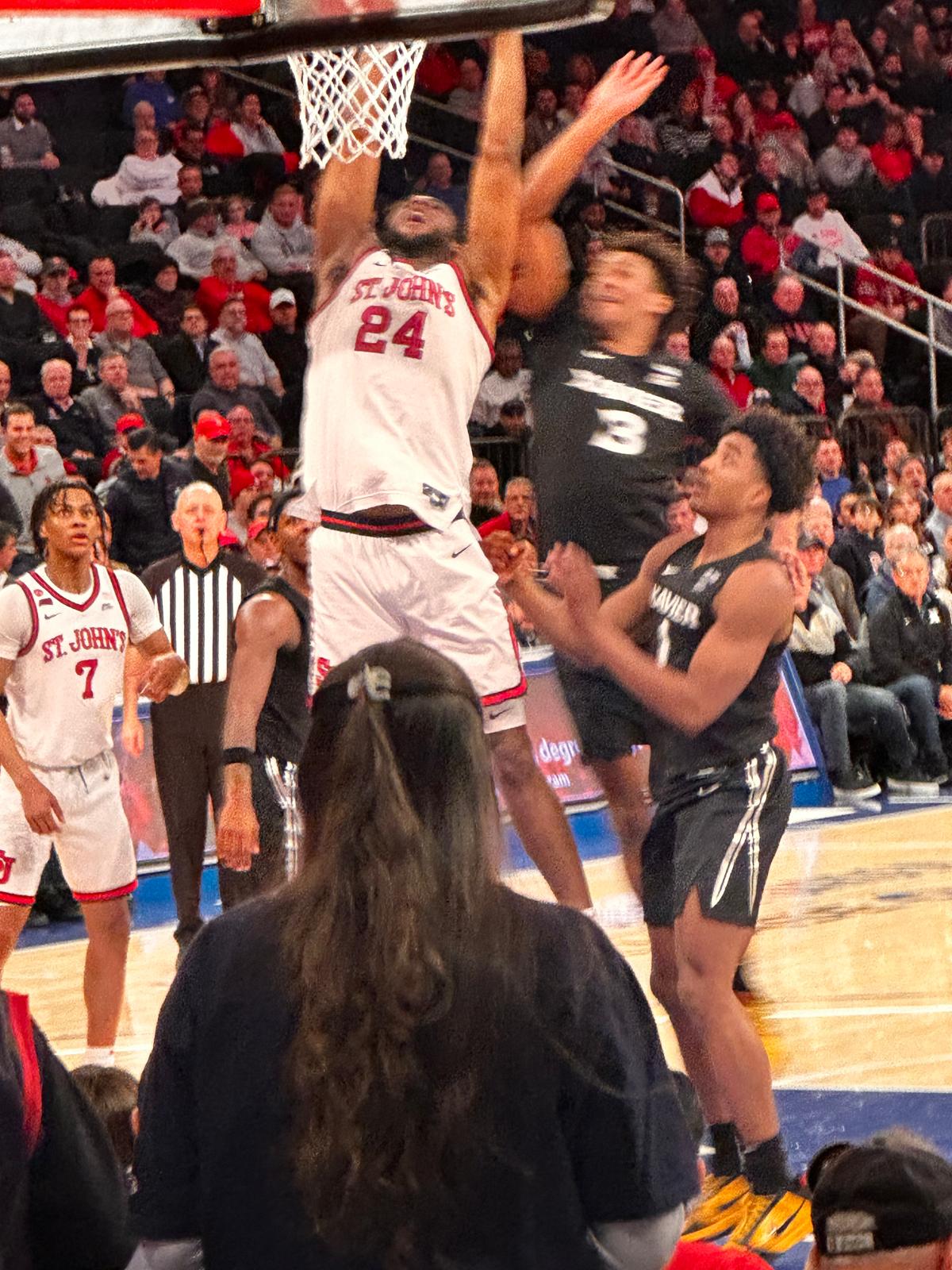
In a split second, the ball would not fall clean.
It struck the front rim first, the way doubt often arrives, blunt and public, before glancing upward again, suspended for a heartbeat beneath the lights of Madison Square Garden. For a moment it seemed to hover there, undecided, as if the building itself had drawn breath and refused to release it.
Four bodies converged beneath it.
Sneakers barked against hardwood.
Elbows flared.
Hands reached.
Then Zuby Ejiofor rose.
He did not glide the way the long-limbed giants of a previous era once glided. He did not stretch above everyone with wingspan alone. He drove upward with two feet planted firmly beneath him, hips sealed into space he had claimed a half-second earlier. His shoulders widened. His hands closed around the ball with certainty rather than hope.
He landed hard.
And before gravity could reclaim the moment, he rose again.
Two points. Foul. Roar.
The Garden did not cheer so much as convulse, the sound rising in waves from the lower bowl to the rafters where memory hangs heavy and unforgiving. Strangers grabbed one another’s sleeves. A father leaned into his son and shouted something neither would remember clearly, except for the feeling.
That was not just a rebound.
It claimed ownership.
And in that instant, New York understood something that had been building for months.
The modern giant does not tower above the game.
He arrives twice.
New York Tests the Fifth Big
Before the roar in Manhattan, there were quiet minutes in Lawrence.
At Kansas, the stat line told a modest story. Five minutes a night. 1.2 points. 1.7 rebounds. Sixty-five percent from the field, mostly from the margins of the action, finishing plays others had initiated.
He occupied the dunker spot.
Filled space.
Clapped for teammates.
Crowds cheered louder for others. Cameras followed others. Draft boards circled others.
He waited.
Waiting can corrode a young player, planting resentment and teaching him to chase validation instead of detail.
Instead, he studied.
He studied angles when the shot left a guard’s fingertips. He learned how misses bend off iron differently depending on arc and spin. He practiced wedging a forearm into a defender’s hip without drawing a whistle and pivoting on balance rather than brute force, exploding off two feet rather than drifting off one.
Most players measure worth in minutes.
He began measuring it in preparation.
There were nights in Lawrence when he replayed possessions in the dark of his dorm room, the way some players replay applause. A late hedge. One slow rotation. The rebound surrendered because his stance rose an inch too high.
Talent opens doors.
Detail keeps them open.
When he entered the transfer portal, he did not seek comfort. He sought a crucible.
He found one in Queens.
Installation: A Program Restored
When Rick Pitino came to St. John's University, he did not promise banners. He promised discipline. He promised a system that would hold even when emotion threatened to spill over.
Roles, in his program, are not awarded. They are installed.
Practice moved with velocity. Closeouts carried angles, not guesses. Hedges demanded footwork that felt foreign at first. Conditioning extended past comfort, past the point where legs tremble and breath shortens and excuses begin to whisper.
Film sessions felt surgical.
One afternoon, Pitino froze the screen mid-possession. Zuby stood upright at the top of a pick-and-roll, his stance a shade too tall.
“That posture,” the coach said quietly, “gets you scored on in March.”
There was no lecture. No raised voice.
The silence carried the lesson.
From that day forward, he bent lower. He widened his base. He shortened his slides. He spoke earlier on switches. When a guard drove baseline, he arrived at the block before the help call finished forming.
Transformation did not arrive in applause.
It arrived in repetition.
The corrected hedge.
An earlier seal.
One extra sprint after a made basket.
By midseason, teammates began glancing at him before free throws, searching for alignment. He pointed, spoke, and set the defense before the ball crossed half-court.
At Kansas, he waited for minutes.
In Queens, he began claiming the floor.
The Hidden Work: A Position Rewritten
Most fans see height.
Few see feet.
Watch him closely on a missed shot. He does not crash wildly. He steps early, reading the angle off the rim before the ball completes its descent. He flips his hips around a box-out with leverage, sliding into the crease between shoulder and rib.
He plants two feet and rises straight up.
The numbers confirm what the eye senses. A 14.6 percent offensive rebounding rate. More than four offensive boards per game. Free throws drawn at a rate that turns collisions into consequences.
But statistics only describe the surface.
The deeper story lives in his balance, his ambidextrous finishes through contact, his ability to hedge twenty feet from the rim, then recover without fouling.
He does not erase space the way seven-footers once did.
He invades it.
Giants in Big East Cathedrals
The Big East Conference built its mythology on giants.
In the 1980s, power meant height. Patrick Ewing guarded territory. Alonzo Mourning punished entry. Dikembe Mutombo erased space with reach alone.
The rim belonged to them.
In the 1990s, bruisers like Derrick Coleman claimed the block as property, scoring through contact and anchoring their teams with physical authority.
Then the floor stretched.
Spacing widened the geography of the game. Guards hunted mismatches. Centers hedged higher and recovered faster. Passing from the short roll became as valuable as finishing from the post.
The archetype shifted.
The old big protected paint.
The modern big protects possession.
This is where Zuby stands.
He does not tower like Ewing.
He does not overwhelm like Coleman.
He connects.
Three and a half assists per game from the center position signal a brain at work, not merely a body. Two blocks per game reflect timing, not intimidation. Double-digit rebounds per forty minutes reveal anticipation more than height.
He is not nostalgia, but transition.
A Queens School at the Heart of the City Game
New York does not fall in love quickly.
It studies labor.
In Queens, work begins before sunrise. Storefront lights flicker on while the sky still hangs gray over Liberty Avenue. Delivery trucks idle. Shopkeepers lift metal gates. Immigrant families build quietly, incrementally, measuring success not in headlines but in sacrifice.
Zuby fits that rhythm.
He did not arrive with lottery projections or endorsement glow, but with habit. A habit that bends lower than most stars, runs harder after made baskets, and resets faster after contact.
In barbershops, they talk about him differently.
Not as a scorer.
As a worker.
“He plays like he needs it,” a man says over the hum of clippers.
That sentence matters here.
Because New York respects hunger that does not relax.
When he grabs a second jump rebound, the crowd responds not only to points. They respond to effort made visible. The city sees itself in repetition.
Adoption in this city does not come through marketing.
It comes through recognition.
The Voice of Resilience
There was a January morning when conditioning ran long enough to strip pretense from the room.
Breath shortened.
Legs trembled.
Sweat darkened the floor beneath sneakers.
Fatigue does not negotiate.
A guard missed a rotation late in the drill. The ball found the corner. The shot splashed clean.
Pitino’s whistle did not scream.
It cut.
Silence settled over the gym like weight.
In that silence lived the standard.
Before the coach could step forward, Zuby did.
He did not gesture wildly. He did not perform authority.
“Angle first,” he said, steady and precise. “Force baseline. I’ll be there.”
At Kansas, he had waited for instruction.
In Queens, under a coach who measures men by response under strain, he began delivering it.
That shift matters.
Because in Pitino’s system, resilience is not emotion. It is repetition under pressure. A stance held when lungs burn and communication delivered when fatigue tempts silence. The refusal to drift when the game speeds up.
Resilience here is architecture.
Close the gap.
Tag the roller.
Two feet in the paint.
Sprint back after a made basket.
Detail after detail.
Possession after possession.
Zuby absorbed that language until it stopped sounding borrowed and started sounding native. He stopped reacting to the system and started embodying it.
By February, teammates no longer waited for Pitino’s whistle.
They looked at Zuby.
He pointed, aligned, and reset the defense before chaos gained momentum.
That is not charisma.
That is command.
Queens recognizes that posture. The borough that builds before dawn does not trust noise. It trusts the worker who returns to stance again and again, who speaks when structure wavers, who absorbs demand and translates it into action.
Zuby became that translator.
The Resilient Big.
Not merely a rebounder.
Nor merely a scorer.
A stabilizer.
When a possession fractures, he seals space.
As fatigue creeps, he lowers his stance.
When doubt flickers, he speaks first.
That voice carries forward.
Because in March, the closeout must arrive before doubt does.
In that suspended second, the one between rim and rebound, the system either holds or it breaks.
Teammates now look to him before that moment arrives.
They trust he will wedge inside, arrive twice, and reset the floor when adrenaline threatens structure.
That is not statistical growth.
It is installation complete.
A player who once waited is now the man who anchors.
And when Queens sees that steady, disciplined, unshaken posture, it recognizes its own ethic reflected back.
In this city, belief is built through resilience.
Through this program, resilience is built as standard.
In Zuby, the two align.
And that alignment is what rises in March.
The Measure of March
March comes to New York the way weather comes off the river.
It does not ask permission.
It arrives with memory.
Old highlight calls creep back into apartments at night.
Talk radio sharpens by morning.
Subway chatter turns into bracket talk.
And Madison Square Garden waits, because the Garden always waits.
Not for hype.
For proof.
This month does not reward poetry.
It rewards structure that holds when the body screams.
It rewards the closeout that arrives on time, the box-out that lands first, the pass that comes before panic, the second jump that turns a miss into a sentence.
The ball strikes iron.
It pops up, then hangs.
Four bodies crash beneath it, and for a fraction of a second the season balances on inches and breath.
Then the difference shows itself.
Not in height.
In habit.
Zuby steps early.
He wedges inside without reaching and seals with hips, not hands.
His two feet plant like stakes in concrete.
He rises, lands, and rises again.
The whole story in one motion.
The Garden no longer reacts with surprise. It reacts with recognition.
Because over months of repetition, over thousands of sprints after made baskets, over film sessions where mistakes froze and standards did not move, he built something the city cannot ignore.
Expectation.
He once averaged five quiet minutes behind blueblood names.
Now he commands forty because the system trusts him.
He once cleaned up what others created.
Now he creates stability when possessions crack.
Six foot nine.
Two hundred forty five pounds.
Lower stance.
Clear voice.
Second jump.
No entitlement.
Only standard.
And when the ball floats above the rim in March and the building holds its breath, New York already knows what will happen.
Not because it hopes.
Because it has watched it happen too many times to doubt it.
Belief here is not given.
It is built.
Zuby’s city.
And in this city, belief is earned or it does not exist.
#ZubysCity #StJohnsBasketball #RelentlessRedStorm #BigEastBasketball #RickPitino #ZubyEjifior #MarchMadness #CollegeBasketball #MadisonSquareGarden #QueensBasketball #Resilience #SecondJump #ModernBig #NCAAHoops #RedStormNation #BuiltForMarch #NYCBasketball #BigEastHoops #StJohnsUniversity