St. John’s Beats Rutgers 104–99 in 4OT | Rick Pitino
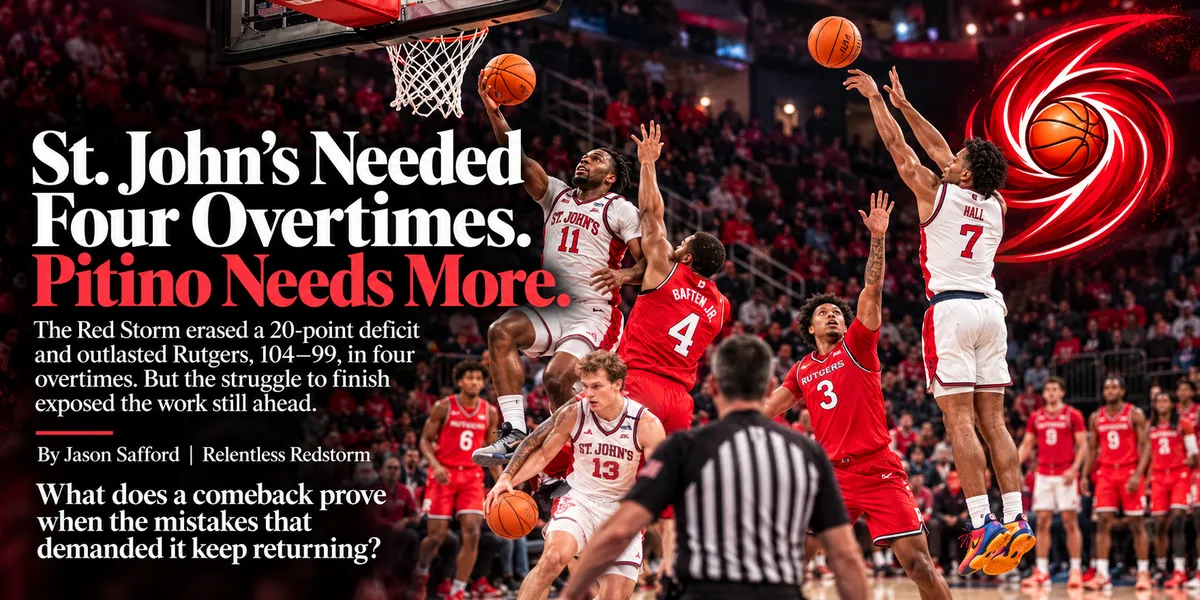
St. John’s Needed Four Overtimes. Pitino Needs More.
The Red Storm erased a 20-point deficit and outlasted Rutgers, 104–99, in an exhibition. The comeback revealed its talent. The struggle to finish exposed the work still ahead.
By Jason Safford | Relentless Redstorm
What does a comeback prove when the mistakes that demanded it keep returning?
Across 60 minutes at Madison Square Garden, St. John’s showed how much its talent could repair and how much its decisions still put at risk.
The Red Storm finally beat Rutgers, 104–99, in four overtimes Sunday. Keyshawn Hall and Ian Jackson scored 24 points apiece. Quinn Ellis helped connect the comeback and close the victory. Yet St. John’s made only one field goal in the final overtime. Eight free throws supplied the rest of its scoring. After so many unsettled possessions, the Red Storm found its surest answer in the unguarded shot.
For Rick Pitino, the score settled the game without settling the questions. His players had recovered from a poor first half. They had found offense through one another. They had also surrendered chances to finish long before the fourth overtime. The afternoon offered evidence of progress, not proof that the repairs would hold.
The trouble appeared in two Rutgers possessions late in the first half. RaSheed Jones tipped in a miss with 1:31 remaining. On the next trip, Lino Mark missed a layup. Christian Gurdak followed with another putback. Rutgers led, 42–25. Two missed shots had become four points for the team that missed them.
Those extra chances supported an offense St. John’s already struggled to contain. Tariq Francis created shots, while Mark pressured the defense with the ball. Gurdak supplied a target inside. Rutgers made 17 of 30 first-half attempts. St. John’s made 11 of 30, including one of eight threes. The Scarlet Knights took a 46–28 lead into halftime through skill as well as persistence.
Calling Rutgers scrappy would leave too much of its afternoon unexplained. Gurdak finished with 20 points and 15 rebounds. Francis scored 24, and Mark added 14. The Scarlet Knights won the glass, 58–51, and collected 18 offensive rebounds. Their own mistakes would matter later. Their early command was earned.
Pitino’s roster brought substantial experience to that test, but much of it came from elsewhere. Ellis had played for Olimpia Milano. Babacar Sane arrived from Germany’s MHP Riesen Ludwigsburg. Hall came from Auburn, and Tounde Yessoufou came from Baylor. Jackson, Ruben Prey and Lefteris Liotopoulos returned with knowledge of Pitino’s demands. What the group had learned separately still had to become something five players could use together.
That task reaches beyond learning where to stand. A defensive call has to produce the right response from a teammate. One player’s position determines what another can protect. Conditioning has to preserve those movements when the game grows difficult. Pitino needs shared habits without losing the judgment that makes each player valuable. Rutgers had provided a demanding test of that balance.
The second half supplied a different answer. Rutgers scored first to stretch its lead to 48–28. Hall responded with a three-pointer. Jackson followed with a layup and free throw. Ellis found Sane for two baskets during the early recovery. Prey collected an offensive rebound and dunked, giving St. John’s the second chance it had too often surrendered.
Then the leading scorers began creating for each other. Hall assisted Jackson’s three with 13:17 remaining. Thirty seconds later, Jackson found Hall for a three. Hall’s free throws tied the game at 52. Prey stole the ball and dunked for the lead. The deficit disappeared through a sequence of different players doing useful work.
That response deserves weight equal to the criticism. St. John’s outscored Rutgers, 43–25, in the second half. Its shooting improved to 15-for-28, while Rutgers fell to 7-for-32. The Red Storm found better results at both ends. Rutgers also stopped converting the opportunities that had sustained its first half. The game had changed, even if neither team could yet take control of its ending.
Sane carried both the promise and the interruption of that recovery. He scored 13 points and grabbed six rebounds. He made six of eight attempts inside the arc but missed all four threes. Three turnovers cut into his production. With 13:26 remaining, he committed a foul and turnover on the same play, then came out. Later, he returned and followed his own miss with a basket. His ability kept helping St. John’s, but his decisions did not always preserve what it gained.
Sane and Jackson are the captains, giving the example they set particular weight. Their scoring supplied essential answers against Rutgers. Leadership also lives in what follows a mistake. The returning players had uneven afternoons of their own. Prey supplied four assists but finished with two rebounds. Liotopoulos lost the ball during the first half and fouled six seconds later. Experience gave Pitino a foundation for correction, not an exemption from needing it.
Ellis brought considerable order to the offense. He finished with 13 points, nine assists, eight rebounds and four blocks. His passing helped teammates find productive places in the game. Earlier pressure at the rim could strengthen that work. A decisive attack makes a defender choose between stopping the ball and staying with another scorer. Ellis does not need to become less generous to make those choices harder.
Hall’s 14 rebounds and two blocks represented substantial defensive work. The remaining collective assignment includes actions that produce no individual statistic. An early warning prepares a teammate for a screen. An active hand can delay a pass. A sound angle can redirect a drive. Those decisions help the other four defenders only when anticipation supports the coverage rather than abandoning it.
And someone still has to secure the ball.
Even after recovering the lead, St. John’s could not close regulation. Ellis committed his only turnover with 1:05 remaining. Darin Smith Jr. followed with a tying three. Gurdak’s free throws put Rutgers ahead, 71–69. Ellis answered with a layup with 23 seconds left. His afternoon contained both the costly decision and the play that kept it from deciding the game.
The first overtime brought another escape. Prey fouled out early, leaving Reed Bailey with a larger role. Ellis made a tying three, but Rutgers moved back in front. Yessoufou tied the score at 76 with a layup off an Ellis pass. St. John’s gained another chance to win before Ellis missed at the horn. Five extra minutes had produced no separation.
Yessoufou’s finish offered a useful direction for his offense. He made one of seven threes, compared with four of eight two-point attempts. Early in the second overtime, he finished a Bailey pass with a dunk. One exhibition does not establish his shooting limits. It did show the value of getting him toward the basket. His strength becomes more influential when the defense has to deal with it closer to the rim.
The second overtime supplied some of St. John’s clearest team offense. Bailey assisted baskets by Hall and Yessoufou. Ellis found Jackson for a layup and a three, then Hall for another layup. All five made field goals came from assists. The offense had become a series of players making the next player useful. The problem was no longer whether St. John’s could create a lead, but whether it could protect one.
Hall’s free throws made it 89–87 with 23 seconds left. Ellis fouled Francis one second later. Francis made both, and Jackson missed the final layup. The third overtime ended with another missed opportunity. After Bailey tied the game at 94, Hall turned the ball over with 11 seconds remaining. Francis missed the final attempt, sending both teams into a fourth extra period.
Rutgers scored first again. Hall answered by rebounding his own miss and finishing inside. It would be St. John’s only field goal of the period. Jackson, Ellis and Hall supplied the rest from the foul line. Two late turnovers kept Rutgers close, but the free throws held. St. John’s finally finished a game it had repeatedly brought within reach.
The victory leaves Pitino with specific work rather than a general demand for improvement. His players can study the passes that created five assisted baskets in one overtime. They can study the decisions that surrendered the advantage those baskets built. The staff has to distinguish a late recognition from a failed technique or a poor choice. Each requires a different correction. The evidence that the lesson has taken will be the next comparable possession.
That responsibility cannot remain entirely with the coach. The players already showed they could change the quality of their basketball within a game. The harder step is making that quality dependable. Captains and returners have an example to establish. Newcomers have responsibilities to make their own. Five players have to carry the standard once the ball moves beyond Pitino’s reach.
Texas visits the Garden on Sunday, October 25, for the final exhibition. The most useful signs of progress may arrive before either team builds a lead. They may appear in an early defensive call or a controlled possession after a mistake. They may come from an attack that forces help and creates a teammate’s shot. They will also appear when the first attempt misses. Against Rutgers, that moment repeatedly separated an incomplete effort from a finished possession.
With 43 seconds left in the fourth overtime, Hall turned the ball over. St. John’s led by two. Darren Buchanan Jr. missed with 23 seconds remaining, and Hall collected the rebound. Ellis made two free throws on the possession that followed. Rutgers received no second shot that time. After an afternoon of difficult repairs, St. John’s helped secure the victory by completing an ordinary defensive assignment.
The comeback showed what St. John’s could survive. That rebound showed what it needs to repeat.