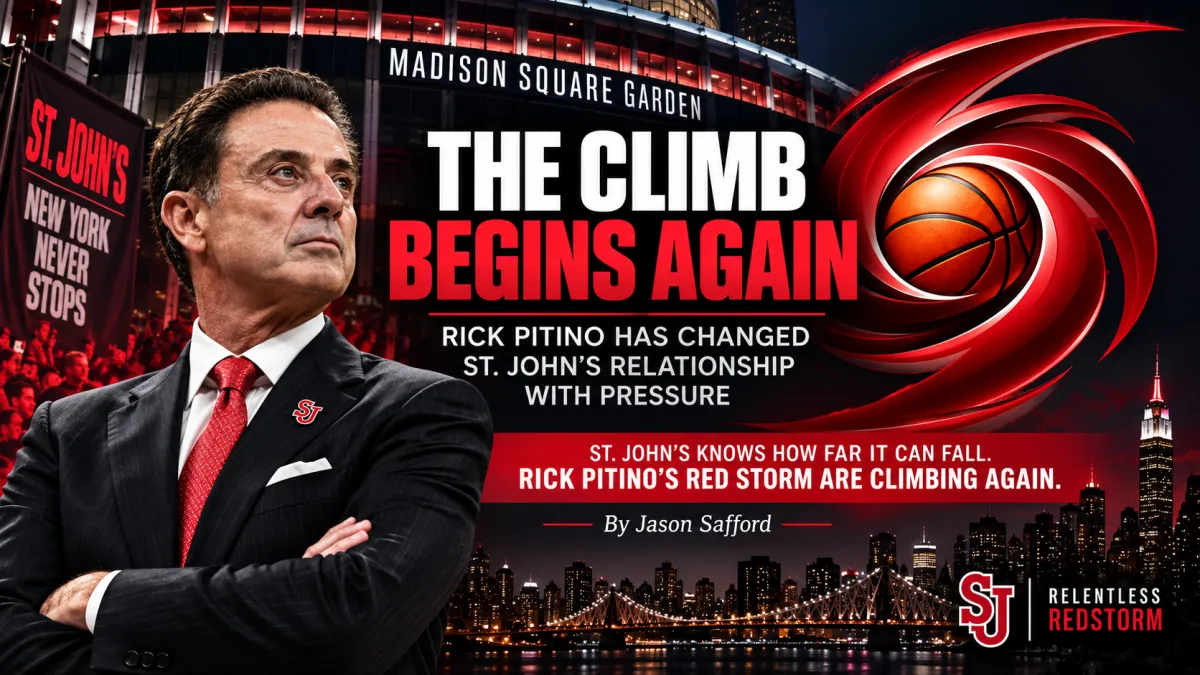
The Climb Begins Again: Rick Pitino Has Changed St. John’s Relationship With Pressure
THE CLIMB BEGINS AGAIN: RICK PITINO HAS CHANGED ST. JOHN’S RELATIONSHIP WITH PRESSURE
St. John’s spent the summer rebuilding after a painful March exit. Now Rick Pitino’s program faces a different challenge: carrying the weight of everything it has become.
By Jason Safford
The hardest climb begins after you know how far you can fall.
The season did not really end when the horn sounded against Duke. It followed St. John’s out of Washington and into an offseason that never seemed to slow down. The Johnnies had led by 10 in the second half of their Sweet Sixteen game. They stood close enough to feel another door opening after years spent fighting back toward the national stage. Then Duke drove through the heart of the defense until the lead disappeared and the season went with it. Rick Pitino did not hide behind missed shots or search for somebody to blame. He said St. John’s could not stop Duke’s “bully drives,” and inside that blunt diagnosis lived the first truth of the season that followed.
The pain ran deeper because this was no ordinary St. John’s season. The Red Storm finished 30-7, won a second straight Big East regular-season championship, won the conference tournament again, and reached the Sweet Sixteen for the first time since 1999. They set a Big East record with 36 conference wins over two seasons and went 25-2 at Madison Square Garden during that span. The old building had begun to feel like St. John’s territory again. Noise filled the seats. Expectation replaced hope. New York basketball had begun beating through the program again.
Yet none of that could stop the silence after Duke. Success had brought St. John’s close enough to hurt again, and Pitino refused to mistake that hurt for failure. He told his players they had earned a bronze medal, not the gold they wanted, but something real enough to respect. He praised what they accomplished while speaking openly about how deeply the loss hurt. Pitino does not ask his teams to ignore disappointment. He asks them to face it, learn what it exposed, and decide what comes next. The 2026-27 season begins there, not with a transfer announcement or an NIL figure, but with a response.
The Wound Became the Starting Point
Only two days after Duke ended the season, St. John’s answered its first major question. Pitino signed a new agreement that keeps him in Queens through the 2029-30 season, while reports placed his future annual compensation around $6 million. St. John’s does not disclose the full terms of its private contract, but the message needed little explanation. Athletic Director Ed Kull said the extension showed confidence in Pitino’s leadership and vision. Then Kull went further, saying Pitino had changed “the culture of our community.” St. John’s did not wait for the pain to fade before deciding who would lead the next climb.
That decision showed how far the program had moved in three years. St. John’s no longer wondered whether Pitino could make its basketball team interesting again. The crowds had returned. Trophies had arrived. National relevance no longer belonged only to old highlight films. Now the school had to turn that attention into something durable enough to survive roster turnover, changing rules, and the rising cost of competing at the top. The extension made Pitino the center of St. John’s bet on what its basketball program could become through the end of the decade.
Then nearly everything around him changed.
The Summer Became a Test of Adaptation
Three St. John’s players were selected in the NBA Draft, the first time that had happened in the modern draft format. Zuby Ejiofor went in the first round, ending a 14-year St. John’s drought there. Bryce Hopkins and Dillon Mitchell followed in the second. Dylan Darling transferred to Grand Canyon, Joson Sanon moved to West Virginia, and other pieces departed through graduation, transfer, or eligibility. One national report estimated that St. John’s lost nearly 50 points per game from the previous season. Pitino was not filling a few holes. He was rebuilding almost the entire team.
The old model of college recruiting would barely recognize what came next. Pitino searched the transfer portal, European professional leagues, international development systems, and high school basketball. He worked inside a market reshaped by NIL and revenue sharing. Players from Benin, England, Senegal, Hungary, Nigeria, Serbia, Portugal, Greece, and Sweden entered the wider roster picture. Some had played major college basketball. Others had played professionally in Europe or spent time around the G League. Pitino had spent more than five decades learning college basketball, yet this version demanded that he learn it again.
Tounde Yessoufou became the brightest symbol of that new world. He arrived from Baylor after averaging 17.8 points and 5.9 rebounds while setting freshman school records for points and field goals made. EvanMiya ranked him as the No. 2 transfer in the country. On3 placed his estimated NIL valuation around $5 million, while other reporting cited in the research dossier put his St. John’s compensation near $6 million. Those numbers remain estimates rather than public contracts. Their size still shows how far college basketball has traveled from the game most longtime St. John’s fans knew.
Pitino responded to all that value in a way that sounded much more familiar. He praised Yessoufou’s toughness and scoring, then pointed directly toward what still needed work. He wanted more rebounding, better shooting, and stronger one-on-one play if Yessoufou hoped to become the lottery pick Pitino believed he could be. Then he reduced the challenge to a few words: “good is the enemy of great.” The money had changed, and the marketplace certainly had. The demand inside the building had not. Talent could bring a player to Queens, but the standard would decide what happened after he arrived.
That standard became more believable when Pitino turned it on himself. He admitted this summer that the staff had misused Ian Jackson by asking him to play point guard after failing to recruit a true one. Jackson had spent much of the season organizing an offense when his instincts pushed him toward attacking and scoring. Pitino did not bury the mistake inside coaching language. “I screwed up,” he said. He moved Jackson back to the two-guard, called him a potential MVP-level player, and changed the roster around him. Accountability did not stop at confession. It became action.
Quinn Ellis became part of that correction. The 6-foot-5 guard arrived from Olimpia Milano after averaging 8.3 points and 4.5 assists in EuroLeague play. Pitino described him as a throwback point guard who sees the floor and makes teammates better. Ellis handed out 11 assists in one summer scrimmage, the kind of number that speaks directly to what the offense had lacked. He did not arrive simply because St. John’s wanted another talented guard. He arrived because Pitino identified a mistake and changed course. The coach demanded adaptation from his players, then showed them what it looked like himself.
Then the Opponent Became Uncertainty
The roster might have settled there in another era. This one refused to cooperate. Donnie Freeman, a major transfer from Syracuse who averaged 16.5 points and 7.2 rebounds, tore his Achilles and will miss the season. Djordije Jovanovic will remain overseas after visa problems prevented him from joining the team. Gildas Gimenez will not join because of academic eligibility issues. Each problem came from a different place, but each produced the same result. A player Pitino expected to coach disappeared from the usable roster before the opening tip.
The legal questions became harder to plan around. Reed Bailey joined St. John’s after Indiana, where he averaged 8.3 points and 3.4 rebounds while shooting 57 percent. His fifth year sits inside ongoing court challenges to NCAA eligibility rules. Keyshawn Hall enters a similar landscape after receiving a fifth year through court action, with questions still open when he committed. Both could become important rotation players. A judge’s decision can now change a depth chart almost as quickly as an ankle injury.
College basketball no longer operates under one clean eligibility story. Courts have opened NCAA rules to new legal attacks, but no single decision has erased those rules across the country. Different players have received different relief in different cases. The NCAA has also changed its eligibility model while older waiver routes have closed. Coaches now build teams inside overlapping systems that can move during the same offseason. The modern roster needs coaches, a general manager, compliance staff, immigration help, and sometimes lawyers.
International recruiting adds another layer. NCAA eligibility and immigration status do not run on the same clock, so a player can satisfy one system and still encounter trouble in another. St. John’s has already felt that problem through Jovanovic’s absence. Pitino cannot call timeout against federal law, fix a visa with a baseline play, or stop an Achilles from tearing. He can build enough depth and flexibility to survive when conditions turn against him. St. John’s did not assemble a team under stable conditions and wait for November. It kept rebuilding while the ground beneath the roster moved.
The Price of Competing Has Changed Too
For generations of St. John’s alumni, the financial numbers may feel almost as strange as the legal ones. Reported Big East NIL spending now reaches levels that would have seemed impossible during the Carnesecca years. Estimates place Yessoufou and Ellis above $10 million combined, although those figures remain reported valuations rather than disclosed contracts. Players now possess economic power that previous generations never enjoyed. Schools, donors, agents, collectives, conferences, and courts are still trying to determine what this new system should become. Meanwhile, games still have to be won.
Pitino has argued that Big East schools need a meaningful NIL spending floor if the conference expects to compete nationally. He may dislike parts of the new structure, but he does not use that dislike as permission to fall behind. He recruits inside the world that exists while trying to influence the one that comes next. That may be one of the strangest parts of his St. John’s run. A coach who began working before the transfer portal, NIL, revenue sharing, and global roster building now competes through all of them. Endurance would mean lasting this long. Pitino keeps changing without surrendering the standards that allowed him to last.
The Organization Has Begun to Move With Him
Steel now rises on the Queens campus. St. John’s is building a basketball practice facility of roughly 50,000 square feet, with multiple courts, strength areas, hydrotherapy space, team lounges, and video rooms. Construction began in February, structural steel topped out in August, and completion is expected in spring 2027. A $32.5 million gift, the largest single financial commitment in university history, helped drive the project, with roughly $25 million directed toward the basketball facility. The building will never make a jumper or fight through a screen. It does show that St. John’s has begun matching basketball expectations with basketball infrastructure.
That confidence reaches beyond campus. University President Rev. Brian J. Shanley chairs the Big East Board of Directors, while Kull chairs the conference’s athletic directors group for 2026-27. Pitino did not create those positions, and his success should not receive credit for everything happening around St. John’s. What basketball has created is urgency. Winning has given the university another reason to think bigger about what the program can become. That ambition now reaches from recruiting budgets to construction steel, conference leadership, and Madison Square Garden.
New York can feel it without seeing an organizational chart. St. John’s averaged 13,098 fans across 17 home games last season, an increase of nearly 1,900 per game. The program played 13 games at Madison Square Garden, its most in the building’s current location since 1968. The Big East Tournament averaged 19,812 fans per session. Those numbers measure attendance, but they cannot measure anticipation. The building sounds different when people expect something. The crowd arrives carrying possibility instead of memory alone.
St. John’s basketball lives in families as much as record books. One generation remembers Lou Carnesecca. Another remembers Chris Mullin, Walter Berry, Mark Jackson, and Malik Sealy. Some remember the years when the Garden felt too large and March belonged to somebody else. Those memories did not disappear when Pitino arrived. He gave them company. St. John’s fans can remember what the program was while wondering how far this one might go.
Now Comes the Hardest Test: Expectation
Last season still carried some joy of rediscovery. This season carries something heavier. Bart Torvik’s preseason model places St. John’s at No. 11 nationally and first in the Big East while projecting a top-12 defense. Yet the same model shows only 17.8 percent of last season’s minutes returning. That gap between talent and familiarity may tell us more than any recruiting ranking. St. John’s has enough ability to dream big and enough turnover to make every prediction dangerous.
Talent says St. John’s can dream. Continuity says slow down. Yessoufou may become the offensive star Pitino expects, Ellis may provide the point guard structure the offense lacked, and Jackson may thrive with a role that fits his instincts. But they must learn how to defend together, communicate under pressure, and recover from mistakes beside teammates who did not share last season’s habits. The 2025-26 team finished among the country’s best defenses and improved late in the season. That identity does not transfer with the uniforms. It must return one possession at a time.
The possibilities remain wide. The analytical scenario model sees a path toward another Big East championship and a deep March run if the legal questions settle, the stars perform, and the defense survives the turnover. A middle path still produces a strong tournament team. The downside appears if eligibility problems remove important pieces and chemistry never catches the schedule. Those scenarios are analysis rather than outside forecasts. They reveal the tension surrounding this team. St. John’s may have enough talent to become one of America’s best teams, but talent alone cannot tell us what happens next.
Pitino has no interest in protecting his new team from that question. Syracuse awaits at Madison Square Garden. The Players Era Festival sends St. John’s into a major field in Las Vegas. Arizona comes to the Garden. Alabama waits in Birmingham. Pitino wants those games because strong opponents expose weak places before March does. Duke taught St. John’s what happens when the game finds a weakness and keeps attacking it.
That lesson leads directly back to Washington. Duke exposed what St. John’s could not stop. Pitino named it, then spent the summer rebuilding the roster, correcting roles, widening the recruiting map, and preparing for problems he cannot control. None of those moves promises a better ending. They reveal how the program now responds when something hurts. The loss becomes information. Information becomes a decision. The decision becomes the next standard.
Eventually, Every Culture Becomes Behavior
Pitino can establish that standard, but he cannot live it for his players. He cannot slide his feet when a guard turns the corner. He cannot crash into a body for a rebound, sprint back after a turnover, or fight through a screen while Madison Square Garden rises behind him. Yessoufou must decide whether good becomes great. Jackson must turn his corrected role into production. Ellis must make teammates better when Big East pressure comes hunting for the ball. Eventually, every culture becomes behavior.
There will be nights when the jumper dies on the rim and somebody beats St. John’s down the floor. A guard will turn the corner. A big man will miss the rotation. Pitino will explode from the sideline while thousands rise behind him. Five new teammates will have seconds to decide whether frustration becomes another mistake or the next defensive stop. Nobody will care what the roster looked like in August. The response will happen in sneakers, sweat, contact, and noise.
That is where Pitino’s culture either becomes real or collapses into language. Resilience looks easy in summer when every recruit appears to be an answer. It becomes measurable when the first plan fails and five players must decide what happens on the next possession. Do they point fingers or communicate? Do they jog back or sprint? Does the missed shot remain in their heads, or does somebody dive onto the floor ten seconds later? The court will tell us whether the standard traveled far enough.
Then the Garden will tell us whether the city still believes.
Imagine the first night when all of this finally becomes basketball. The lights fall, the introductions begin, and a new group runs onto the Madison Square Garden floor wearing the same St. John’s name that generations carried before them. Some arrived from major college programs. Others came through professional basketball in Europe. Some fought through injury, eligibility questions, or uncertainty just to reach the starting line. Then the ball goes up, and none of the valuations, legal filings, recruiting rankings, or summer predictions can guard anybody.
Five players still have to trust one another.
A sneaker squeaks. A shoulder hits a chest. Somebody fights through a screen. Ellis pushes the ball. Jackson attacks a seam. Yessoufou rises toward the rim while the Garden begins coming out of its seats. One possession becomes another, and suddenly 19,000 people are leaning toward the same rectangle of hardwood, waiting to discover what this team does when the game pushes back. That is the moment all the summer talk has been moving toward.
That is what Queens is waiting to feel.
The Climb Begins Again
You can hear the sound already. The bar comes down, you pull it once to make sure, and then the chain catches beneath the car. The first click sounds quiet, almost harmless, but anybody who has taken the ride before knows what comes next. Last March taught St. John’s what the fall feels like. The Johnnies had Duke in trouble and watched the path close before them. The new roster does not erase that memory. It inherits it.
And climbs anyway.
This time, St. John’s carries more talent, more money, more expectation, and perhaps more uncertainty than any team Pitino has built in Queens. Court rulings can change a rotation. Immigration questions can change a roster. Injuries already have. Players from different countries, leagues, and basketball systems still have to become one team before some of the nation’s best opponents begin testing them. Pitino cannot control every force pushing against St. John’s. He can control the response.
That response now belongs to everyone else. The staff must teach it. The players must live it when their legs burn and the game starts slipping away. The university must support it when the season gets difficult. Alumni will carry it into the Garden with memories of everything St. John’s once was and hope for what it might become. New York will measure it the way New York measures every team that asks to matter, not by what it promises, but by what it does when pressure arrives.
Nobody knows where the car stops this time. Nobody knows whether March brings another fall or takes St. John’s somewhere this generation has never been. That was never the promise. Pitino cannot promise the summit, and resilience cannot guarantee a championship. It can only prepare people for the moment when the climb becomes steep and turning around starts looking easier.
St. John’s knows how far it can fall now.
And still, Queens is getting back on.
Click.
Click.
Click.
Welcome back to the ride.