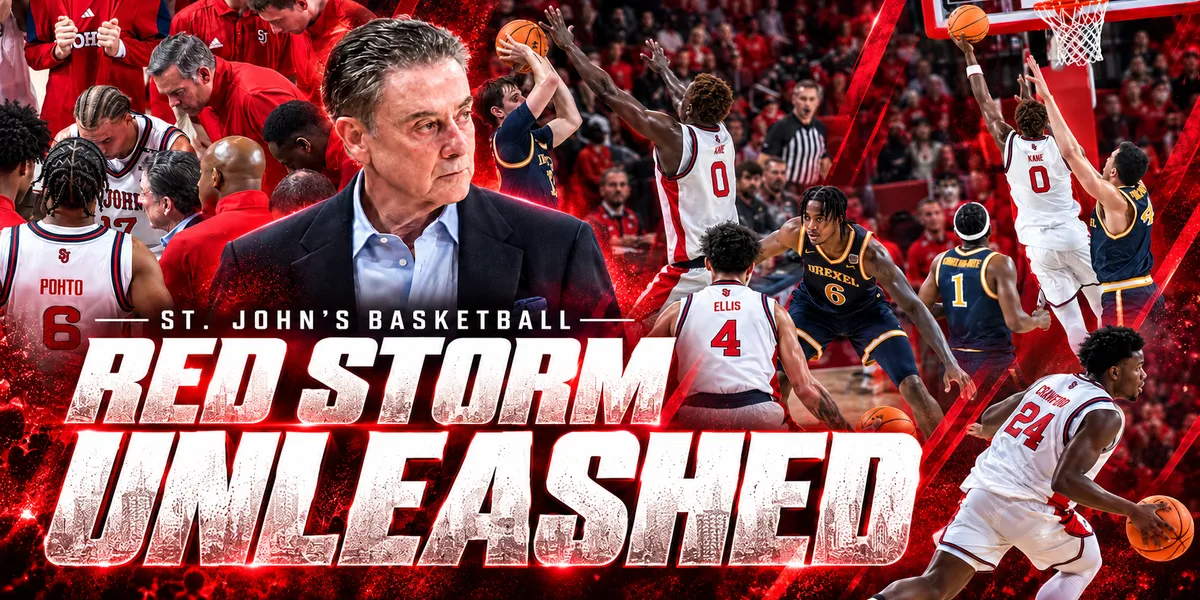
St. John's vs. Drexel: Rick Pitino's Red Storm Unleashed
RED STORM UNLEASHED
Rick Pitino won a daring offseason gamble and unveiled a frightening collection of talent against Drexel. Now comes the greater wager: turning extraordinary individuals into one team capable of making history.
By Jason Safford | Relentless Redstorm
Rick Pitino spent the offseason playing the highest-stakes hand of his St. John’s career, gambling on extraordinary talent, navigating legal battles, and wagering on a chance to make history, and when the cards finally began to turn over Wednesday night in Queens, an 81–52 demolition of Drexel revealed a frightening possibility: he had assembled enough talent to conquer almost anyone, but had yet to prove these gifted men could become one team.
The first glimpse came with all the contradiction such a gamble deserves. Drexel scored the game's first five points. St. John's answered with a three-pointer from Tounde Yessoufou. The Red Storm stole the ball, and Yessoufou fed Babacar Sane for a three-point play. The visitors regained the lead before the game settled into a struggle. Then Pitino's collection of athletes began to reveal what made them so dangerous.
They ran. They reached. They attacked.
Drexel tied the game at eleven with 14:35 remaining in the first half. Over the next eleven minutes, St. John's unleashed a 24–3 run. The Dragons missed shot after shot and repeatedly surrendered possession. Sane scored from outside. Keyshawn Hall attacked the basket. Reed Bailey stole the ball, and Yessoufou finished above the rim. By the time St. John's led 35–14, the difference in physical force had become unmistakable.
Yet the score offered only a first impression. Drexel cut that 21-point lead to twelve before halftime. St. John's missed open opportunities and committed careless turnovers. Players still searched for the proper spacing and timing. The same team that could explode down the court sometimes struggled to execute in the half court. Power had arrived before precision.
For the 5,260 people at Carnesecca Arena, the night offered a preview of uncommon possibility. Pitino's players combined strength, speed, length, and athletic reach with skills learned across different basketball worlds. Their defense could expand across passing lanes and collapse around the basket. Their offense could strike in seconds. Their physical presence made portions of the contest look like men competing against boys. But their collective understanding had barely begun to develop.
That is what made the exhibition more compelling than its final score.
Pitino had won enough of his offseason gamble to put these players together. Now he faced a different challenge. He had to turn a remarkable roster into a dependable team.
And the hardest part of his work was only beginning.
The gamble before the game
The most revealing part of Wednesday's victory began before anyone stepped onto the court.
One day earlier, Pitino attended a Queens court hearing involving Hall's eligibility. A judge maintained a temporary order that allowed the Auburn transfer to play. As Pitino left the courthouse, he learned that Quinn Ellis had received NCAA clearance. Within hours, two major pieces of his roster had gained the right to compete. Neither development had come through ordinary basketball preparation.
Ellis arrived from professional basketball in Italy. Hall brought proven scoring from the Southeastern Conference. Sane had played professionally overseas and in the NBA G League. Their paths to Queens reflected a changing college basketball landscape. Transfer rules, professional experience, NCAA decisions, and legal challenges had become part of roster construction. Pitino had spent considerable energy navigating that uncertain ground.
Even success carried limits. Hall remained protected by a temporary court order rather than a final judgment. Sane faced another eligibility hearing scheduled for November 9. Reed Bailey's status also involved legal uncertainty. The coach had assembled his players without securing every part of their future. Wednesday's lineup represented a significant achievement, but not a permanent guarantee.
Other plans had already collapsed. Donnie Freeman, the highly regarded Syracuse transfer, suffered an Achilles injury during the summer. He would miss the season before appearing in a game. Pitino had to absorb that loss while preparing an almost entirely reconstructed team. No amount of recruiting ambition could eliminate the risks that followed.
The stakes had grown because St. John's was no longer building from obscurity.
Pitino's program had won consecutive Big East regular-season and tournament championships. Last season's team reached the Sweet 16. Those achievements had restored expectations around the Red Storm. Yet Zuby Ejiofor, Dillon Mitchell, and Bryce Hopkins were gone. Their production and established relationships could not simply be handed to new players.
Instead, Pitino assembled another group with even broader possibilities. He recruited proven college scorers, international professionals, and developing young talent. Their abilities suggested many ways to attack an opponent. Their backgrounds also meant they had learned different responsibilities in different systems. What worked for one player elsewhere might conflict with what another expected.
Recruiting had provided the ingredients.
The real transformation would require these men to change one another.
Ellis brings the electricity
The strongest evidence of that possibility did not come from the leading scorer.
Quinn Ellis made no field goals against Drexel. He attempted only two shots and scored three points. Those numbers would normally describe an uneventful debut. Instead, Ellis became one of the night's most revealing performers. His six assists led the Red Storm. He added six rebounds, four steals, and two blocked shots while committing only two turnovers.
Ellis supplied something more valuable than another scoring option. He offered control within the speed.
St. John's has enough athletes to race down the floor without much encouragement. But speed becomes dangerous when five players see different opportunities. One attacks while another expects a pass. A cutter arrives before the ball. A rushed decision gives the opponent an opportunity to run. The faster this roster plays, the greater its need for shared timing.
Ellis showed an early ability to manage that tension. His first assist found Yessoufou for the Red Storm's opening three-pointer. Later, he connected with Sane for another three in transition. He fed Yessoufou for a basket that extended the first-half lead. His passing gave different scorers chances to influence the game. He made his presence felt without demanding the spotlight.
Consider what happened during the decisive first-half surge. Sane converted a transition three on a pass from Ellis. Twenty-eight seconds later, Ellis found Yessoufou for a layup. The two scorers threatened Drexel in different ways. Their point guard recognized both opportunities. In those brief possessions, individual gifts began serving a common purpose.
That was the electricity Ellis brought to Queens.
The voltage came from his ability to connect action with opportunity. He pushed the pace without needing to dominate every possession. His defensive activity created additional chances. His passing allowed teammates to become dangerous before defenses recovered. The ball did not need to remain in his hands for his influence to continue.
His professional experience offers a valuable foundation. Ellis spent years competing in Italy and the EuroLeague. He arrived with experience managing games against seasoned opponents. But his new teammates must still learn his reads and decisions. Experience gives him tools for that assignment. It does not eliminate the need to build relationships.
Afterward, Ellis acknowledged that the newcomers still needed to get "on the same page." The phrase carried more weight than a routine observation about chemistry. St. John's must learn what each player's movement means. It must recognize when a teammate needs help and when he needs space. These decisions must become instinctive at competitive speed.
Ellis may be the player who makes that connection possible.
Yet even his impressive debut carried limits. The Red Storm still committed nineteen turnovers. The offense struggled at times when its transition chances disappeared. Ellis cannot direct every possession or prevent every mistake. Eventually, his teammates must learn to make the right decisions without him. The strongest evidence of his leadership will emerge when his influence survives his absence.
For one night, however, St. John's discovered something essential.
It had a point guard capable of making other gifted players more dangerous.
Sane commands the floor
If Ellis supplied the electricity, Babacar Sane brought the force.
The Senegalese forward scored 17 points in twenty minutes. He collected eight rebounds and made three of four attempts beyond the arc. He finished near the rim and converted in transition. He added a blocked shot, a steal, and two assists. No St. John's player scored more. His performance provided the night's clearest display of individual physical command.
Sane did not need to remain near the basket to impose himself. He could shoot from outside and attack closer to the rim. His strength challenged defenders in crowded areas. His rebounding gave St. John's another way to regain possession. His range stretched the areas an opponent had to protect. Drexel faced a forward who could influence several parts of the game.
But complete command requires more than extraordinary ability.
Sane committed five turnovers, the most on the team. Some of his decisions interrupted the very momentum his talent helped create. He showed the power to change a possession and the impatience to waste one. That contradiction revealed an important part of his development. Sane could dominate stretches of the exhibition without yet mastering every demand of Pitino's system.
The distinction matters because Pitino has made Sane a captain alongside Ian Jackson. The role demands judgment as well as production. Sane must recognize when to attack and when to move the ball. He must help teammates maintain discipline when the game becomes frantic. His responsibility extends beyond winning individual contests. He must help establish the habits of a successful team.
His situation also carries a burden beyond the court. Sane's eligibility dispute concerns his previous professional experience. He played Wednesday under temporary legal protection. His future availability remains subject to another hearing. The uncertainty gives each opportunity greater importance without making his basketball future entirely his to control.
Still, the player has choices of his own. He can improve his decisions. He can learn where teammates expect him to move. He can help establish standards through his daily work. Those choices matter regardless of how the legal process unfolds. They also reveal why leadership involves more than physical dominance.
Against Drexel, Sane looked like a player capable of taking command of a game.
The larger question is whether he can help command the habits of a team.
Yessoufou offers the first taste
Tounde Yessoufou entered St. John's with a different kind of expectation.
He had averaged 17.8 points as a freshman at Baylor. He arrived in Queens as one of the country's most highly regarded transfers. The Big East placed him on its preseason First Team. Those credentials suggested a player capable of becoming a central offensive force. But Wednesday offered only a small sample of his possibilities.
Yessoufou scored nine points. He made four of nine field-goal attempts. He collected four rebounds, three steals, and a blocked shot. He did not commit a turnover. His performance touched several parts of the game without demanding constant possession.
It felt like the first appetizer in a season-long meal.
He opened the Red Storm's scoring with a three. His early steal led to a Sane basket. He finished near the rim and converted in transition. His late first-half dunk delivered one of the game's clearest displays of power. Each contribution revealed a different part of his basketball range.
Yet Yessoufou never attempted to consume the entire offense. His defensive work created opportunities. His movement gave Ellis passing options. His finishing ability threatened Drexel around the basket. He provided value without needing twenty shots. That balance may become especially important as Pitino searches for combinations that work together.
There is more to discover. Yessoufou made only one of five three-point attempts. His scoring fell well below his previous college average. Stronger defenses will challenge his decision-making and shot selection. The Red Storm will need him to develop reliable answers when opponents remove his first option. His growth may become one of the season's most revealing stories.
For now, the opening performance should sharpen the appetite rather than satisfy it.
A player with Yessoufou's athletic gifts offers possibilities that one exhibition cannot measure. One game may reveal his transition finishing. Another may test his perimeter shooting. A difficult opponent may demand that he create opportunities against a settled defense. Every challenge could reveal another part of his game. The progression will depend on the work he puts into each new responsibility.
Wednesday offered the first course.
The season will determine how rich the rest of the menu becomes.
The returning players face a different test
While the newcomers displayed their possibilities, Ian Jackson and Ruben Prey faced a more demanding question.
Both played for Pitino last season. Both know the program's expectations. Both experienced the pressure of Big East competition and the NCAA Tournament. Their familiarity with the system should give them an advantage. It also raises the standard by which their performances must be judged.
Jackson returned to Queens with a chance to assume greater responsibility. The Bronx guard had averaged 9.4 points in limited minutes last season. He entered the new year as a team captain and preseason All-Big East First Team selection. Those honors reflected confidence in his potential. Now he must translate that promise into dependable production.
His exhibition began poorly. Jackson missed all five of his three-point attempts. He scored only twice from the free-throw line before halftime. His shooting struggled to find rhythm. Yet he continued to move the ball and finished with three assists. The second half offered a more encouraging response.
Jackson scored eight points after the break to finish with ten. He converted two dunks following St. John's steals. His speed and finishing ability returned when the game opened up. But those baskets did not resolve the deeper concern. Against disciplined opponents, transition chances will not always come so easily. Jackson must find ways to influence the offense when defenses remain organized.
His responsibility also extends into the locker room. As captain, he helps connect the team's previous standards with its new personnel. He knows the demands Pitino places on defensive effort and preparation. He must now help others meet those demands while improving his own game. Familiarity with the system gives him responsibility, not immunity from competition.
Prey faces a similar test in the frontcourt.
The Portuguese forward ended last season with an impressive shooting performance against Duke. He made all four of his three-point attempts in the Sweet 16. His height and shooting touch offered the possibility of a versatile offensive weapon. With established frontcourt veterans gone, his opportunity has expanded. The question is whether his overall production will grow with it.
Against Drexel, Prey scored six points in fifteen minutes. He collected two rebounds and blocked a shot. He made one of two attempts from beyond the arc. He also committed two turnovers. The performance provided flashes without establishing control of his larger responsibilities.
Rebounding remains an immediate concern. Drexel collected fourteen offensive boards. Prey alone cannot be blamed for that problem. Still, St. John's needs dependable frontcourt rebounding and defensive positioning. His shooting offers one reason to keep him on the floor. His ability to protect possessions must provide another.
The newcomers are not waiting quietly for their opportunities. Bailey produced eight points, five rebounds, and three steals in fourteen minutes. He made every field-goal attempt. Freshman Theo Edema scored six points in nine minutes and added a block. Keyshawn Hall contributed nine points and five rebounds off the bench. Each offered Pitino another reason to reconsider how he distributes playing time.
This is where the offseason gamble becomes personal.
Jackson and Prey must raise their performance while helping newcomers adapt. Established scorers may receive fewer shots. Experienced players may surrender minutes to better combinations. Young athletes may discover that effort alone does not secure a place in the rotation. The competition will reveal who can accept a different role without losing the desire to improve.
The greater the talent, the harder those decisions become.
And Pitino now has more talent than minutes.
Two hundred minutes, fourteen players
A regulation college basketball game gives a coach 200 player-minutes.
Not 250. Not 300.
Two hundred.
That is the one limit Pitino cannot recruit, coach, or negotiate his way around.
Wednesday, fourteen St. John's players appeared against Drexel. Ellis played a team-high 26 minutes. Jackson received 24, Yessoufou 23, and Sane 20. Hall contributed in nineteen minutes. Bailey, Edema, and others made their cases from the bench. The reserves combined for 36 points.
The depth offered Pitino flexibility. It also exposed the coming struggle over opportunity.
Every substitution changes the responsibilities of five players. Every lineup offers different strengths and weaknesses. A bigger group may defend the rim while giving up speed. A smaller lineup may create more scoring space while losing rebounding strength. The best combination against one opponent may struggle against another. Pitino must discover which players function best together, not simply which players are best individually.
These choices carry consequences for the men involved. One player may lose minutes despite practicing well. Another may receive an opportunity because of an opponent's particular strength. A returning player could see a newcomer take an established role. Someone accustomed to scoring twenty points may need to defend and rebound without many shots. Each decision tests the balance between personal ambition and team responsibility.
There is no easy formula for that work.
Pitino can establish standards, teach assignments, and demand discipline. He can reward performance and correct mistakes. He can experiment with combinations until patterns begin to emerge. Yet his players must make the daily decision to support one another. A coach cannot manufacture trust through substitution alone. His authority creates the conditions, but the players must build the relationships.
That is the alchemy Pitino has ignited.
He has brought together men from different basketball worlds. Each arrives with proven ability and individual ambition. The transformation requires those strengths to change through their relationships. Ellis must create opportunities others know how to recognize. Sane must use his power without disrupting the offense. Yessoufou must expand his game while serving the group.
Jackson and Prey must turn experience into leadership. Hall, Bailey, Edema, and the remaining players must make their minutes meaningful. Every man must understand how his decisions influence teammates. The goal is not to make gifted players less ambitious. It is to build a team where helping others succeed increases everyone's opportunity to win.
That cannot be achieved in one exhibition.
It will demand months of competition, correction, and sacrifice.
The danger hidden inside the victory
The Red Storm's defensive production against Drexel was remarkable.
Nineteen steals. Eight blocked shots. Twenty-five forced turnovers. Thirty-three points scored from Drexel's mistakes. Twenty-two fast-break points.
Those numbers describe a team capable of creating overwhelming pressure.
The physical dimensions of its defense offer intriguing possibilities. Long defenders can challenge passing lanes. Athletic forwards can contest shots and recover near the basket. Quick guards can turn mistakes into scoring chances. When those actions connect, the entire floor becomes difficult for an opponent to navigate. Drexel experienced that pressure during the decisive first-half run.
But the statistics also expose the limits of the performance.
St. John's committed nineteen turnovers of its own. It made seven of 29 three-point attempts. Remove Sane's three makes, and his teammates shot four of 25 from deep. Drexel matched the Red Storm's 43 rebounds. The Dragons also collected fourteen offensive boards. Those are significant weaknesses for a team hoping to compete against the country's best.
Drexel deserves credit for making parts of the game uncomfortable. Adrian Petkovic opened the scoring from outside. Dillon Tingler followed with a basket that made it 5–0. The Dragons later tied the game at eleven. They also recovered enough to cut a 21-point deficit to twelve before halftime. Their resistance showed that St. John's remained vulnerable even while building a commanding lead.
The second half brought a clearer separation. St. John's held Drexel to seven made field goals in 33 attempts. The Red Storm continued forcing mistakes and converting in transition. Jackson contributed more offense. Bailey and the reserves provided further support. By the final minutes, the advantage had grown beyond any realistic challenge.
Still, Drexel's poor shooting complicates the picture. The Dragons made only three of 24 three-point attempts. St. John's deserves credit for its defensive activity. But the box score cannot reveal how many misses came from strong contests rather than poor execution. A more talented opponent may protect the ball and make the shots Drexel missed. Then Pitino's team will need a different way to win.
Pitino understood that danger.
Afterward, he described the team as roughly three weeks to a month behind in its development. He acknowledged how much work remained on the fundamentals. His comments offered an important counterweight to the excitement. The players had demonstrated extraordinary physical ability. They had not yet demonstrated the consistent execution that championship basketball requires.
The coach's central preference was clear. He would rather teach talented players than possess a fundamentally sound team without enough ability. That belief explains much of his offseason strategy. He assembled players with the physical gifts to expand what St. John's could accomplish. Now he must teach them how to make those gifts dependable.
The risk is that exceptional talent can conceal poor habits.
An explosive dunk can follow a broken offensive possession. A steal can rescue a missed defensive assignment. A gifted scorer can make a difficult shot when the offense creates nothing better. Those plays excite crowds and win games. They can also hide weaknesses that stronger opponents will expose.
For St. John's, the greatest threat may not be a shortage of ability.
It may be assuming ability will solve problems that require cooperation.
The wager that matters now
Pitino has spent decades building teams and demanding uncommon effort. His newest St. John's roster gives him an extraordinary range of possibilities. Ellis can control the ball and accelerate the offense. Sane can influence the game through scoring, strength, and rebounding. Yessoufou can attack, defend, and grow into a larger role. Jackson and Prey offer experience within the system.
Hall, Bailey, Edema, and others create further combinations. That depth gives Pitino choices unavailable to many opponents. It also increases the difficulty of establishing consistent roles. The coach must decide when to trust experience and when to reward emerging performance. He must balance structure with freedom. His ultimate success will depend on how effectively his players respond to those decisions.
The next exhibitions will bring sharper evidence. Rutgers visits Madison Square Garden on October 18. Texas follows one week later. The regular season begins November 2 against Monmouth. Each contest offers another opportunity to test combinations and habits. Each also moves the team closer to games that count.
The larger stakes extend well beyond those early dates.
St. John's has restored itself as a major Big East program. Consecutive conference titles have raised expectations. Another deep NCAA Tournament run is a clear ambition. But championships do not follow automatically from recruiting rankings or exhibition victories. They come from sustained execution against opponents capable of punishing mistakes.
The eligibility disputes add uncertainty Pitino cannot fully control. Injuries may change roles. Players will experience poor shooting nights and reduced minutes. Opponents will learn how to attack this team's weaknesses. Some nights will reward power and speed. Others will require patience, judgment, and restraint.
That is what makes the season so compelling.
Pitino has assembled the talent to pursue something significant. The Drexel exhibition offered the first evidence of its range. But no court ruling can create trust. No recruiting success can guarantee sacrifice. No spectacular individual performance can replace the work of five players learning to act together.
The transformation must happen on the floor.
And it will not happen without resistance.
Seven seconds that revealed the challenge
Late in the first half, Drexel lost possession to Reed Bailey.
Bailey immediately gave the ball away.
Then he stole it again.
Quinn Ellis recognized the opportunity and delivered the pass. Tounde Yessoufou finished with a dunk. Seven seconds separated Bailey's first steal from the basket. A mistake had interrupted the possession. A recovery had restored it. Two teammates then turned that recovery into points.
The sequence offered a small but revealing glimpse of Pitino's greatest opportunity.
Bailey supplied the defensive persistence. Ellis recognized the scoring chance. Yessoufou delivered the finish. None needed to dominate the entire possession. Their separate skills became more valuable because they worked together. The result arrived through connected actions rather than individual brilliance alone.
But the mistake mattered as much as the dunk.
Against Drexel, Bailey had another chance to recover the ball. Against stronger opponents, that chance may never come. The pass from Ellis may face a tighter defense. Yessoufou may need another way to score. The team will have to recognize those changes and respond before the opportunity disappears.
That is where the real test begins.
Pitino has assembled men capable of astonishing things. Wednesday proved that much. It did not establish how consistently they can perform those things together. The season will ask whether the group can turn brief moments of connection into dependable habits. Their answer will shape everything that follows.
The offseason was a gamble on talent, opportunity, and ambition.
The exhibition revealed the strength of the hand.
Now comes the wager no recruiter, lawyer, or coach can win alone.
Whether these men will give enough of themselves to become something greater together.
The cards have been dealt.
The season will reveal what they're worth.